
ISO 9001:2026 is the new edition of the quality management system standard, announced by ISO on 16 September 2026, and ISO states that it replaces ISO 9001:2015. The published changes centre on leadership, quality culture, ethical behaviour and accountability, on greater clarity around risks and opportunities, and on a new Annex A that clarifies key terms and the intent of requirements. ASQ states that organizations certified to ISO 9001:2015 have a 3-year period from the date of publication to transition, and your certification body sets the transition audit date.
ISO 9001:2026 is the new edition of the quality management system standard, and it replaces ISO 9001:2015. The published changes concentrate on leadership, quality culture and ethical behaviour, on clearer treatment of risks and opportunities, and on a new Annex A that clarifies key terms and the intent of the requirements. Organizations holding a 2015 certificate have a transition period, and their certification body sets the transition audit schedule.
What ISO 9001:2026 changes, and who this guide is for
According to ISO (2026), ISO 9001:2026, Quality management systems – Requirements, was launched on 16 September 2026. ISO states that the new edition “now replaces ISO 9001:2015” on its ISO 9001:2026 information page. BSI, the UK national standards body, calls BS EN ISO 9001:2026 the standard’s first revision in more than a decade (BSI, 2026).
The reach of the standard explains why the revision matters commercially. ISO reports more than 1 million certificates issued to organizations in 189 countries, making ISO 9001 the most widely used quality management standard in the world (ISO, ISO 9001:2026 standard page). If your customers or tenders ask for ISO 9001, this edition is the one they will ask about next.
This guide is written for the people who have to act on the change:
- The quality manager or management representative who owns an existing ISO 9001:2015 system and needs a gap analysis before a transition audit.
- The owner or general manager who signs off the budget and wants to know about certificate validity, transition period and workload.
- The QHSE or management systems lead running an integrated management system who must absorb the new points without duplicating work.
- The HR or quality lead buying in-house awareness and internal auditor training.
- The first-time implementer setting up a quality management system from scratch.
What changed from ISO 9001:2015
The committee responsible for the standard summarises the revision directly. ISO/TC 176/SC 2 (2026) states that the revised edition introduces a new Annex A to clarify key terms and the intent of requirements. It also reports clearer wording, a stronger focus on leadership, quality culture and accountability, and greater clarity around risks and opportunities.
Leadership, quality culture and ethical behaviour
BSI states that ISO 9001:2026 introduces ethical behaviour and quality culture as part of leadership responsibility (BSI, ISO 9001:2026 key changes and guidance). The American Society for Quality reports the same direction of travel, noting a greater emphasis on quality culture and ethical behavior (ASQ, Quality Progress, 2026).
In practice this lands on top management, not on the quality department alone. Expect to show how leadership and commitment are exercised, and how quality objectives connect to the organisation’s own objectives. Evidence usually already exists in management review minutes, objectives and awareness records. The work is making that evidence match what the clause now asks for.
Risks and opportunities, treated separately
ASQ reports that the revision includes new requirements and places greater emphasis on separating risk and opportunity (ASQ, Quality Progress, 2026). ISO/TC 176/SC 2 describes greater clarity around risks and opportunities in the same edition.
For an integrated management system lead, this is the point to check first. If your planning process puts risks and opportunities in one combined register, review whether each is identified, assessed and acted on in its own right. Risk-based thinking stays the method. The documented output is what may need to change.
Annex A and clearer wording
ISO/TC 176/SC 2 (2026) reports that Annex A is new in this edition, and that it clarifies key terms and the intent of requirements. Read Annex A alongside the clause text, and use it to settle internal arguments about what a requirement is asking for. Where your procedures restate the standard’s wording, check that restatement against the new text.
Telling a requirement from good practice
A requirement is in the clause text and an auditor can ask you to demonstrate it. Good practice is what experienced organisations do to meet that requirement efficiently. ASQ reports that the revision includes new requirements; the published summaries above describe their themes, not their full wording. So work from the licensed text of ISO 9001:2026 itself before you rewrite a procedure, and confirm any change you have heard about secondhand against the clause.
ISO 9001:2015 and ISO 9001:2026 compared, by topic
What the published sources say about the 2026 edition
| Topic | What the sources state about ISO 9001:2026 | Source |
|---|---|---|
| Edition status | ISO 9001:2026 now replaces ISO 9001:2015 | ISO |
| Launch date | Announced on 16 September 2026 | ISO (2026) |
| Scope of revision | The standard’s first revision in more than a decade | BSI (2026) |
| Leadership | Ethical behaviour and quality culture introduced as part of leadership responsibility; stronger focus on leadership, quality culture and accountability | BSI; ISO/TC 176/SC 2 (2026) |
| Risks and opportunities | Greater clarity around risks and opportunities; greater emphasis on separating risk and opportunity | ISO/TC 176/SC 2 (2026); ASQ (2026) |
| Annex A | A new Annex A clarifies key terms and the intent of requirements | ISO/TC 176/SC 2 (2026) |
| Wording | Clearer wording across the edition | ISO/TC 176/SC 2 (2026) |
| Transition | Organizations certified to ISO 9001:2015 have a 3-year period from the date of publication to transition | ASQ, Quality Press |
| Installed base | More than 1 million certificates in 189 countries | ISO |
Transition: how long you have, and who decides
ASQ states that organizations certified to ISO 9001:2015 will have a 3-year period from the date of publication to transition to ISO 9001:2026 (ASQ, Quality Press). Publication of a new edition does not make your current certificate invalid on the day it appears. Your certification body audits and certifies your management system, so it sets your transition audit date.
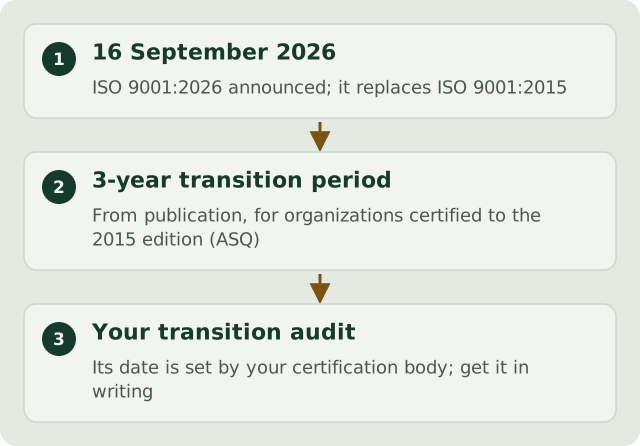
Accreditation arrangements also carry dated transition rules. Global Accreditation Cooperation Incorporated issued its transition requirements for ISO 9001:2026 as version 1.0 on 4 September 2026, and those requirements took effect on 16 September 2026 (Global ACI, 2026). Ask your certification body which transition rules apply to your certificate, and get the date in writing.
Keep the roles straight when you plan the budget. Your organisation implements the system. A certification body audits and certifies it. In Türkiye, TÜRKAK is the national accreditation body. A consultancy prepares and trains you, and nothing more.
A practical gap analysis for an existing system
You adapt the system you have. Rebuilding it from zero is rarely the right answer, and it is usually the most expensive one. A workable sequence looks like this:
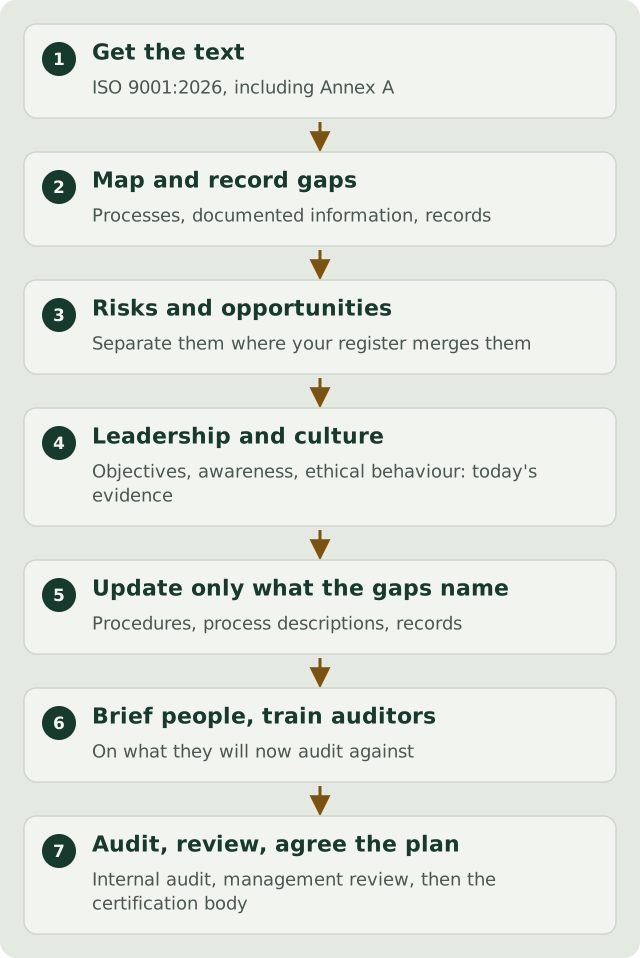
- Obtain the published text of ISO 9001:2026, including Annex A.
- Map your current processes, documented information and records against the new clause text, and record each gap.
- Review how you identify and act on risks and opportunities, and separate the two where your register merges them.
- Review leadership and commitment, quality objectives, awareness and ethical behaviour, and note what evidence exists today.
- Update only the procedures, process descriptions, instructions and records the gap list names.
- Brief the people affected, and train internal auditors on what they will now audit against.
- Run an internal audit and a management review against the updated system, then agree a transition plan with your certification body.
If you run an integrated management system
Audit the shared processes once, not once per standard. Internal audit, management review and the handling of risks and opportunities are the natural places to absorb the new points. Keep a single risk and opportunity method, and make the separation of risk from opportunity explicit within it.
If this is your first quality management system
Build to ISO 9001:2026, since ISO states it replaces ISO 9001:2015. Start with a current-state analysis of how you already work, then design the system around those real processes. A systematic approach beats a folder of borrowed procedures that nobody follows.
What to check before you order consultancy or training
- Confirm the provider is a consultancy and a training firm, and that your certification body remains the party that audits and certifies.
- Ask for a current-state analysis first, and expect a roadmap and a proposal rather than a fixed promise about an audit result.
- Check that the work covers your actual processes, documented information and records, not a generic template pack.
- Ask how risks and opportunities will be separated in your planning process.
- Ask what evidence of leadership, quality culture and ethical behaviour will be prepared with your top management.
- Confirm whether internal audit, management review and audit preparation are included.
- Confirm the training format: on site or online, tailored to your organisation, with a certificate of attendance for participants.
- Agree who talks to your certification body about the transition audit date, and when.
Training your team for ISO 9001:2026
Two audiences usually need training. Managers need awareness of what the edition asks of leadership, including quality culture and ethical behaviour. Internal auditors need to audit against the updated clause text, using Annex A to interpret intent.
Useful in-house topics include quality culture, ethical behaviour, leadership accountability, risks and opportunities, and Annex A. Internal auditor training (iç tetkik eğitimi) should work on your own processes and records, so the audit programme improves immediately. Training can be delivered on site or online, and participants receive a certificate of attendance.
Working with Kalite Pusulası
Kalite Pusulası is a quality management consultancy and training firm. We work within the scopes of ISO 9001, ISO 13485, ISO/IEC 17025, ISO/IEC 17020, ISO/IEC 17065 and FSC. We do not certify or accredit anything; the only certificate we issue is the certificate of attendance participants receive after training.
Our services are these. Current-state analysis and a roadmap. Setting up or improving the system with your own team. Internal audit, management review and audit preparation. Training tailored to your organisation, on site or online, after which participants receive a certificate of attendance. Establish. Improve. Make it sustainable.
If you hold an ISO 9001:2015 certificate, request a current-state analysis against ISO 9001:2026 and we will prepare a roadmap and a proposal scoped to your organisation. If your priority is people, ask about ISO 9001:2026 awareness and internal auditor training. The same approach applies to ISO 13485 for medical device organisations, and to ISO/IEC 17025 for laboratories.
Sources
- International Organization for Standardization (ISO) (2026) — ISO launches update to world’s most widely used quality management standard for a new era of business
- International Organization for Standardization (ISO) — ISO 9001:2026: What businesses need to know
- International Organization for Standardization (ISO) — ISO 9001:2026 – Quality management systems — Requirements
- ISO/TC 176/SC 2 – Quality systems (2026) — ISO 9001:2026 has been released!
- BSI, the UK national standards body (2026) — BSI and ISO update world’s most used quality standard for global trade
- BSI, the UK national standards body — ISO 9001:2026 key changes and guidance
- American Society for Quality (ASQ), Quality Progress (2026) — ISO 9001:2026: Unveiling the updates reshaping the gold standard of quality management systems
- American Society for Quality (ASQ), Quality Press — ANSI/ISO 9001:2026 (American National Standard)
- Global Accreditation Cooperation Incorporated (Global ACI) (2026) — Transition Requirements for ISO 9001:2026
Frequently asked questions
When was ISO 9001:2026 published?
ISO announced the launch of ISO 9001:2026, Quality management systems – Requirements, on 16 September 2026. BSI, the UK national standards body, describes BS EN ISO 9001:2026 as the standard’s first revision in more than a decade.
Is my ISO 9001:2015 certificate still valid?
Publication of a new edition does not invalidate your certificate on the day it appears. ASQ states that organizations certified to ISO 9001:2015 have a 3-year period from the date of publication to transition to ISO 9001:2026. Your certification body audits and certifies your system, so ask it which transition rules apply and when your transition audit falls.
What are the main ISO 9001:2026 changes compared with ISO 9001:2015?
ISO/TC 176/SC 2 reports a new Annex A that clarifies key terms and the intent of requirements, clearer wording, a stronger focus on leadership, quality culture and accountability, and greater clarity around risks and opportunities. BSI states that ethical behaviour and quality culture are introduced as part of leadership responsibility, and ASQ reports new requirements plus greater emphasis on separating risk and opportunity.
Do we have to rebuild our whole quality management system?
No. The usual approach is a gap analysis of your existing processes, documented information and records against the new clause text, then updating only what the gap list names. Training for managers and internal auditors can be tailored to your organisation and delivered on site or online, with a certificate of attendance for participants.